How Shopify Grew From a Store Builder to an $11.5B Commerce Platform
Shopify's subscription and merchant-solutions economics, expanding cash flow, ecosystem, and AI-driven commerce strategy.
In this article 7
Many people first encounter Shopify as a tool for launching an online store.
But it has grown from a website builder into a broad commerce platform.
Shopify generated $11.56 billion in revenue in 2025, up 30% year over year. In Q1 2026, revenue reached $3.17 billion, up 34%.
Subscription revenue made up only about 24% of the total. The larger share came from Merchant Solutions.
Shopify is no longer just selling software. Its revenue is increasingly tied to the transactions its merchants make every day.
1. What Is Shopify, Really?
A better description of Shopify is a commerce operating system.
Beyond storefronts, it provides payments, marketing, customer support, shipping, financing, in-person retail, data, and other tools merchants need to run their businesses.
Four Main Types of Shopify Customers
1. New merchants
These include small businesses, entrepreneurs, and founders of independent brands. In the past, starting an online business meant solving web development, payments, order management, and analytics yourself. Shopify lowered that barrier, making it possible to launch an online store quickly.
2. Growing brands
These businesses often have annual revenue between $1 million and $50 million. As they grow, they need more employee permissions, better analytics, and more sophisticated marketing, so they move to higher-tier plans.
3. Large direct-to-consumer brands
Examples include SKIMS, Supreme, Gymshark, and Allbirds. They need global operations, B2B selling, complex order workflows, and high-performing storefronts, which is why they choose Shopify Plus.
4. Brick-and-mortar retailers
Shopify is also moving into traditional retail. Merchants can run a Shopify online store alongside Shopify POS in physical locations, with shared inventory, orders, and customer data.
2. Shopify’s Business Model: SaaS + Transaction Revenue + Added Services
Shopify does not follow the classic SaaS model of charging mainly per account.
SaaS subscriptions + transaction revenue + value-added services
The first component is subscription revenue. Shopify offers four main plan tiers:
- Basic Shopify for entrepreneurs;
- Grow for growing teams;
- Advanced for scaling brands;
- Shopify Plus for large enterprises.
Subscriptions include software plans, POS Pro, App Store and theme revenue, and domains. Yet this entire category accounted for only about 24% of annual revenue.
The second component is Merchant Solutions: Shopify Payments processing fees, Shopify Capital financing, Shipping, POS hardware, advertising, and Shop Campaigns. This revenue is tied to merchant activity.
Shopify’s revenue as a share of gross merchandise volume (GMV) has stayed around 3.0%–3.1%. As merchants sell more, Shopify has more opportunities to earn from the activity on its platform.
| Period | Shopify revenue growth | GMV growth |
|---|---|---|
| 2023 | 26% | About 20% |
| 2024 | 26% | 25% |
| 2025 | 30% | 29% |
| Q1 2026 | 34% | 35% |
3. Subscriptions Are Only 24% of Revenue; Merchant Services Make Up the Rest
Shopify grew rapidly over the past three years:
| Year | Total revenue | Year-over-year growth |
|---|---|---|
| 2023 | $7.06B | 26% |
| 2024 | $8.80B | 26% |
| 2025 | $11.56B | 30% |
Q1 2026 revenue reached $3.17 billion, up 34%, so growth accelerated further.
Transaction Services Are the Main Growth Engine
1. Subscription Solutions
| Year | Subscription revenue |
|---|---|
| 2023 | $1.837B |
| 2024 | $2.250B |
| 2025 | $2.752B |
Subscription revenue represented 26% of total revenue in 2023, 26% in 2024, and 24% in 2025. In Q1 2026, it reached $750 million, up 21% year over year and again about 24% of the total.
2. Merchant Solutions
| Year | Merchant Solutions revenue | Year-over-year growth |
|---|---|---|
| 2023 | $5.223B | — |
| 2024 | $6.530B | 25% |
| 2025 | $8.804B | 35% |
In Q1 2026, Merchant Solutions generated $2.42 billion, up 39% year over year.
Shopify’s biggest growth engine is no longer just selling software. It is helping merchants complete more transactions.
4. Rising Profitability: From Growth Company to Cash-Generating Company
Alongside revenue growth, Shopify’s profitability has improved quickly.
Its GAAP operating margin was -1.6% in 2023, 12.1% in 2024, and 16% in 2025. Its non-GAAP operating margin rose from 7% to 18%, then to roughly 19%–20%.
Free cash flow improved as well:
| Year | Free cash flow | FCF margin |
|---|---|---|
| 2023 | $900M | 12.9% |
| 2024 | $1.3B | 14.6% |
| 2025 | $2.0B | 17.7% |
Shopify had about 7,600 employees in 2025 and $11.56 billion in revenue—approximately $1.52 million in revenue per employee. That is a highly efficient operating model for a software company.
5. Why Can Shopify Keep Growing?
Shopify does not rely on a single acquisition channel. It has built a broader growth flywheel.
1. Help Existing Merchants Generate More GMV
The central idea is:
When merchants succeed, Shopify succeeds.
As merchant sales rise, Shopify can earn more from payments, shipping, advertising, and financial services. Its incentives are closely tied to its customers’ outcomes.
2. Sell Merchants More Solutions
A merchant may initially buy only the storefront. As the business grows, it can add payments, financing, shipping, POS, advertising, analytics, and other services, increasing the value of the account.
3. Grow With Merchants Through Their Lifecycle
Shopify has a clear path as customers scale:
Entrepreneur → Basic Shopify → growing brand → Advanced Shopify → large brand → Shopify Plus
As a merchant grows, its needs become more complex, and Shopify can keep offering higher-value solutions.
4. Expand the Ecosystem
The Shopify App Store has become a large ecosystem. By the end of 2025 it had more than 21,000 apps spanning marketing, support, finance, logistics, analytics, and other categories.
A richer ecosystem gives merchants more reasons to stay.
5. Expand Internationally
By the end of 2025, Shopify merchants operated in more than 175 countries. Global markets still offer substantial room for growth.
6. Shopify Is Redefining Commerce Infrastructure for the AI Era
For Shopify, AI is not just another feature. It is a way to make merchants more effective.
1. Shopify Magic Lowers the Bar for Content and Marketing
Shopify Magic helps merchants write product descriptions, create marketing content, and automate some operations. AI is giving smaller merchants capabilities that used to require a dedicated marketing team.
2. Sidekick Is an AI Commerce Assistant
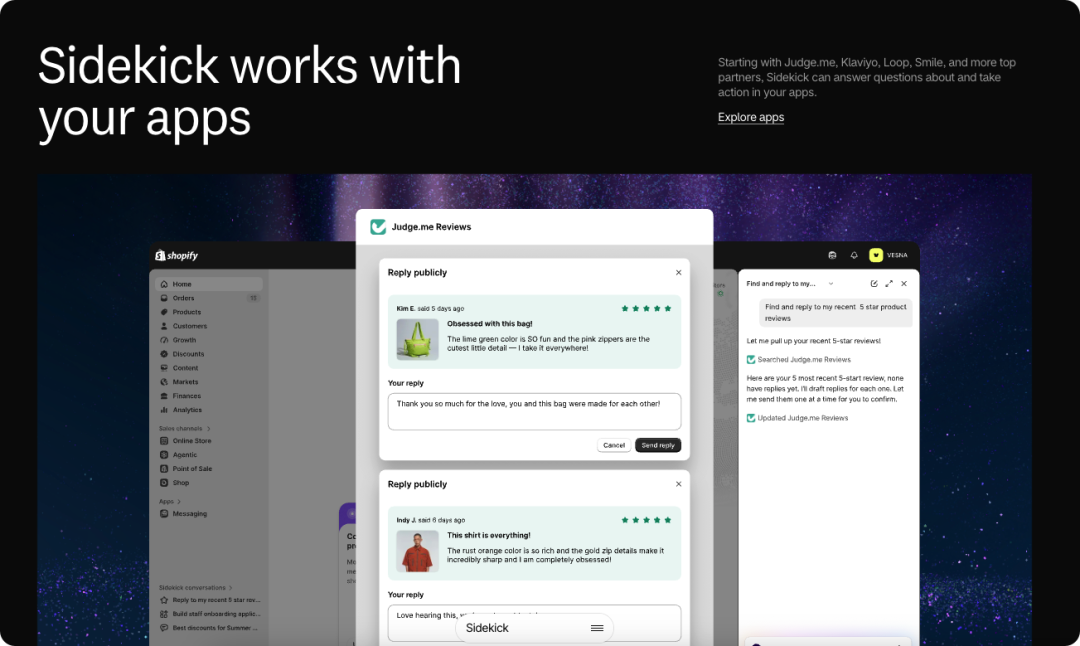
Sidekick helps merchants analyze business data, spot operational issues, make decisions, and carry out some tasks.
In the future, a merchant may be able to manage the business through AI instead of opening multiple admin screens. Shopify is also showing how Sidekick can work with merchants’ other apps.
3. Agentic Commerce Creates a New Entry Point for AI Shopping
Shopify wants to be the infrastructure connecting consumers and merchants in an AI-shopping world. That is why it has increasingly emphasized AI Commerce.
Final Thoughts
If I had to name an exceptionally strong SaaS product, Shopify would be one of the first that came to mind.
It is much more than software for independent online stores. It has built a commerce platform and ecosystem around merchants’ needs. Few companies offer the same combination of tools at this scale.
Its less obvious rivals are Amazon and Stripe. Like Amazon, Shopify benefits as GMV grows: when merchants on its platform sell more, Shopify earns more too.
In the AI era, Shopify has been adapting both its software and ecosystem, expanding AI across more of the merchant experience since 2025. The Winter ‘26 Editions page shows AI reaching many parts of the platform.

In Q1 2026, GMV reached $100.7 billion, up 34% year over year, after 30% growth in 2025. As Shopify adds AI capabilities across its ecosystem, the question is whether it can keep expanding its role in commerce and compete more directly with larger platforms.
————————————————————
Hi, I’m Renee.
I lead SaaS operations and am a big believer in product-led growth. I share SaaS earnings analysis and growth strategy here. If you work on SaaS, I’d love to talk shop.