Amplitude Is Growing Again. Can It Improve Its Margins?
Amplitude's growth has returned, but competition in product analytics keeps sales costs high and margins thin.
In this article 5
In the crowded analytics market, Amplitude’s revenue growth slowed to single digits in 2024 before returning to double digits in 2025 and 2026. Revenue reached $343 million in 2025, up 15%. By Q2 2026, revenue growth had accelerated to 21%, while ARR grew 22% year over year.
Growth is back, but profitability remains a challenge. Amplitude has long spent heavily on sales and marketing. In 2025, sales and marketing represented 55% of revenue, its non-GAAP operating margin was 0%, and its free cash flow margin remained below 10%.
Competition comes from all sides: free GA4, established rival Mixpanel, and fast-growing PostHog. Mixpanel even cut prices and raised its free-tier limits in 2025.
Amplitude illustrates a familiar trade-off: the market can be large and the company can keep growing, but growth gets more expensive when competition is intense.
1. What Is Amplitude?
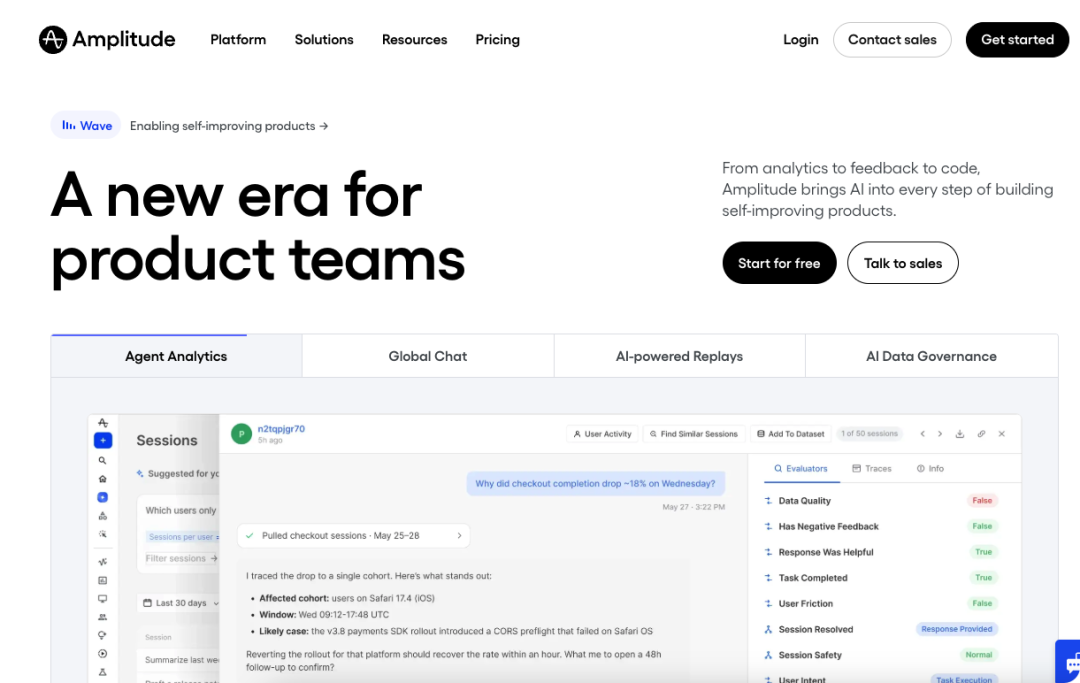
Amplitude is a product analytics tool that helps businesses measure and analyze user behavior across this journey:
User → event → behavior → conversion and retention
Product managers, growth teams, and marketers know the questions well: How many users signed up? Which key actions did they take afterward? Where did they drop off? Which features correlate with better conversion or retention? How does behavior differ across channels and customer segments?
Amplitude’s core value is not simply collecting data. It helps companies understand what users do in a product and which actions actually affect conversion and retention.
The challenge is that analytics is a crowded category. GA4 is free; Mixpanel and Contentsquare compete directly; PostHog appeals to developers; and Optimizely, Statsig, and LaunchDarkly serve experimentation and feature management.
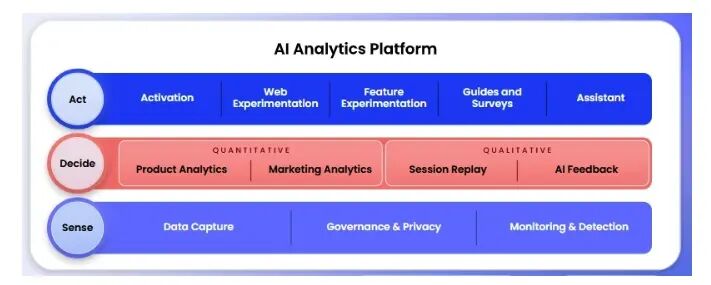
To expand its addressable market, Amplitude has moved well beyond product analytics. It now includes experimentation, session replay, feature management, heatmaps, and marketing analytics, and uses AI to position itself as an AI Analytics Platform.
The goal is to become a broader platform for product teams, not just a product analytics tool. Its product lineup spans data capture and governance, product and marketing analytics, session replay, AI feedback, experiments, activation, guides, surveys, and assistants.
2. $343 Million in Revenue, but Unattractive Margins
Amplitude generated $343 million in revenue in 2025, up 15%, and ended the year with 4,797 paying customers.
As a rough calculation:
$343 million ÷ 4,797 ≈ $71,500
That is not the same as average contract value (ACV), since it divides full-year revenue by a year-end customer count. Still, it suggests that many customers spend meaningful amounts on the product.
At the end of 2025, Amplitude had 698 customers with ARR above $100,000—about 14.6% of its paying customers, or roughly one in seven.
The return to growth did not bring strong profits with it. Amplitude must keep spending heavily on sales and marketing to sustain growth. Its 2025 non-GAAP operating margin was around breakeven. It generated positive free cash flow, but the margin was still in the single digits.
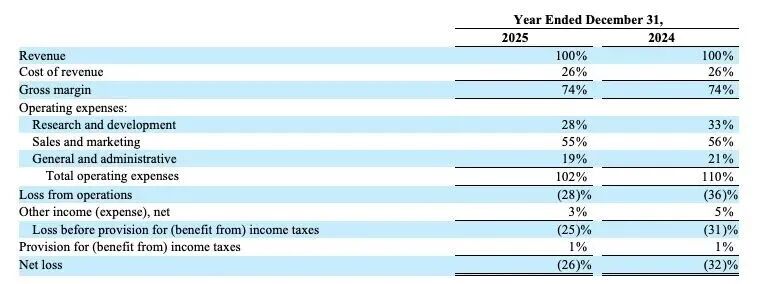
Its reported operating-expense mix helps explain the pressure:
| As a percentage of revenue | 2024 | 2025 |
|---|---|---|
| Gross margin | 74% | 74% |
| Research and development | 33% | 28% |
| Sales and marketing | 56% | 55% |
| General and administrative | 21% | 19% |
| GAAP operating margin | -36% | -28% |
| GAAP net margin | -32% | -26% |
The takeaway is straightforward: Amplitude can grow, but it has to spend heavily to do so.
Customers always have alternatives. If Amplitude is too expensive, they can look at Mixpanel. If they only need basic website traffic and conversion analytics, GA4 is free.
Competition limits pricing power and forces the company to keep investing in product development and sales.
3. Business Model: PLG + Usage Expansion + Direct Sales
Amplitude uses a largely usage-based pricing model. Its main billing metrics are events or monthly tracked users (MTUs), rather than just seats.
| Plan | Pricing model | Best fit |
|---|---|---|
| Free | $0; 2 million events per month | Startups and small teams |
| Plus | Grows with events or MTUs | Growing teams |
| Growth | Custom quote | Mid-market |
| Enterprise | Custom quote | Large companies |
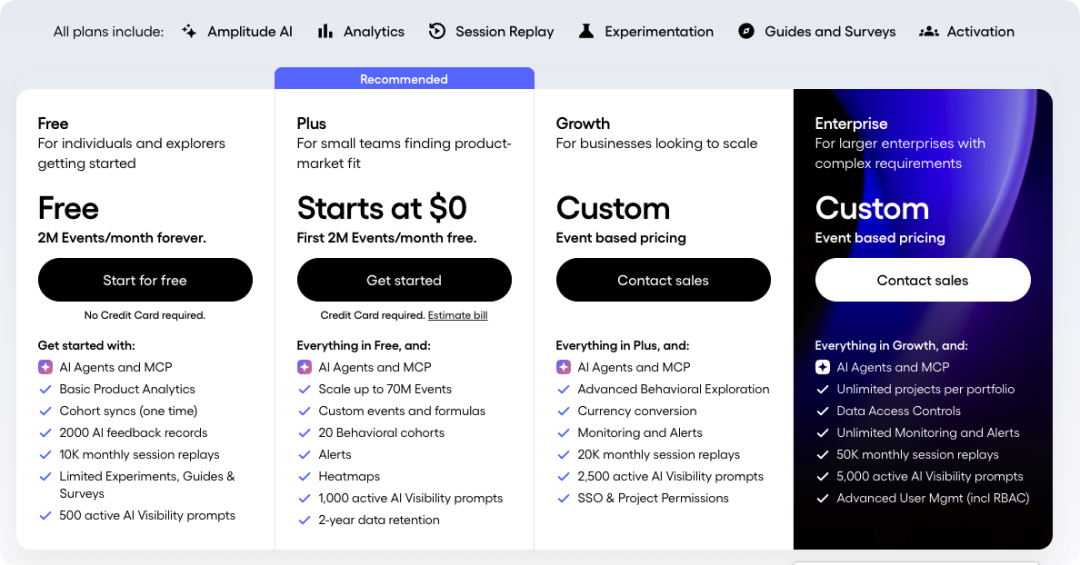
Amplitude’s generous free plan can process 2 million events each month. In a competitive market, asking users to contact sales and sign a contract before they experience value is an easy way to send them to a competitor.
The expansion path looks like this:
Free plan → more product usage → more events or MTUs → paid conversion and expansion → Growth or Enterprise plan → sales-assisted account growth
4. Two Growth Strategies: Win Larger Accounts and Sell More Products
Amplitude has two main growth priorities.
The first is to win more large customers. It had 698 customers with ARR above $100,000 at the end of 2025 and 824 by Q2 2026—126 more in six months, or about 18% growth.
Over the same period, the total number of paying customers rose from 4,797 to about 5,200, an increase of roughly 8.3%.
The $100,000-plus segment grew about twice as fast as the overall paid customer base. Amplitude is clearly trying to increase the share of enterprise customers, not merely maximize customer count.
The second priority is to expand the product line and cross-sell. Customers once bought Amplitude mainly for product analytics. Now it wants them to buy more.
Previously, a company might use Amplitude for product analytics, Optimizely for experiments, LaunchDarkly for feature flags, and FullStory for session replay. Amplitude wants to capture more of that budget itself.
But Amplitude is not alone in becoming a platform. Mixpanel is adding session replay, experimentation, and AI. PostHog has pursued this all-in-one strategy even more aggressively.
Platform expansion can raise average contract value, but Amplitude’s competitors are pursuing the same strategy.
5. Intense Competition Eventually Shows Up in Margins
My takeaway is not that Amplitude is poorly run. After single-digit revenue growth in 2024, it returned to double-digit growth in 2025 and 2026. Large customers are growing much faster than the customer base overall. Its product and sales execution are working.
But it also shows the other side of a highly competitive market: it becomes harder to have both growth and strong profits.
Cut sales and marketing, and growth may suffer. Raise prices, and customers can choose Mixpanel or PostHog. Restrict the free plan, and startups can go elsewhere. Stop building experimentation, session replay, and AI, and competitors may take more of the customer’s budget.
Amplitude has to keep developing products, broadening the platform, and selling while keeping prices competitive. Eventually, those pressures show up in its margins.
That is one reason I think public companies in this category face more pressure than private ones. Investors want not just growth, but proof that growth can turn into profit.
A large market does not guarantee high profits for every company in it. As products become more similar, competition intensifies, and customers gain more options, a greater share of the industry’s value flows to customers rather than staying on SaaS companies’ income statements.
Sources: Amplitude’s 2025 Form 10-K, investor relations materials, and official pricing information.
————————————————————
Hi, I’m Renee.
I lead SaaS operations and am a big believer in product-led growth. I share SaaS earnings analysis and growth strategy here. If you work on SaaS, I’d love to talk shop.