How Klaviyo Built a $1.2B Business in Shopify's Ecosystem
What Klaviyo’s growth reveals about choosing a platform, building around customer data, and growing alongside your customers.
In this article 5
I’ve been reading Klaviyo’s financial reports. Many Shopify merchants use it for email marketing, but after studying its business, customer mix, and growth, I think the more interesting story goes beyond email. Three things stand out.
First, Klaviyo shows that a strong platform ecosystem can support an independent SaaS company with more than $1.2 billion in annual revenue.
Second, Klaviyo doesn’t have to rely solely on a steady stream of new customers. Its revenue can grow alongside the businesses it serves.
Third, for a new SaaS company, choosing a platform is, in a sense, choosing a market. Starting with a valuable, clearly defined niche is often more realistic than building an all-in-one product on day one.
Klaviyo is a particularly good example.
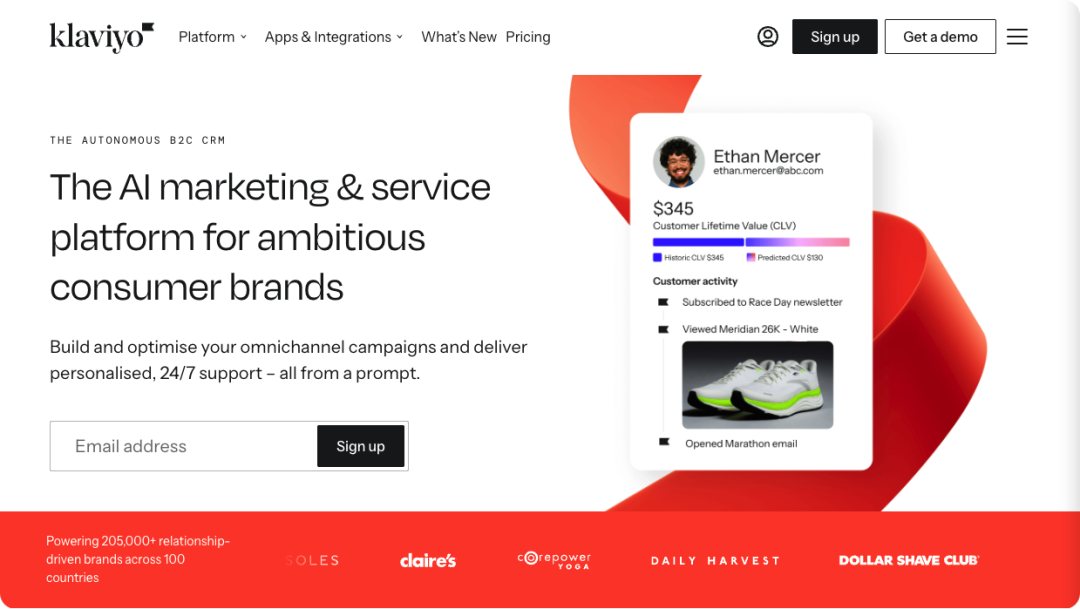
1. Behind $1.2 billion in revenue, I’m most interested in Shopify
Klaviyo generated $1.234 billion in revenue in 2025, up 31.6% from $937 million in 2024. Gross profit reached $921 million, a 74.7% gross margin. Its net loss narrowed from $46.14 million in 2024 to $31.77 million, and customer net revenue retention (NRR) was 109%. As revenue grew, its non-GAAP operating margin improved from roughly 11% to roughly 15%.
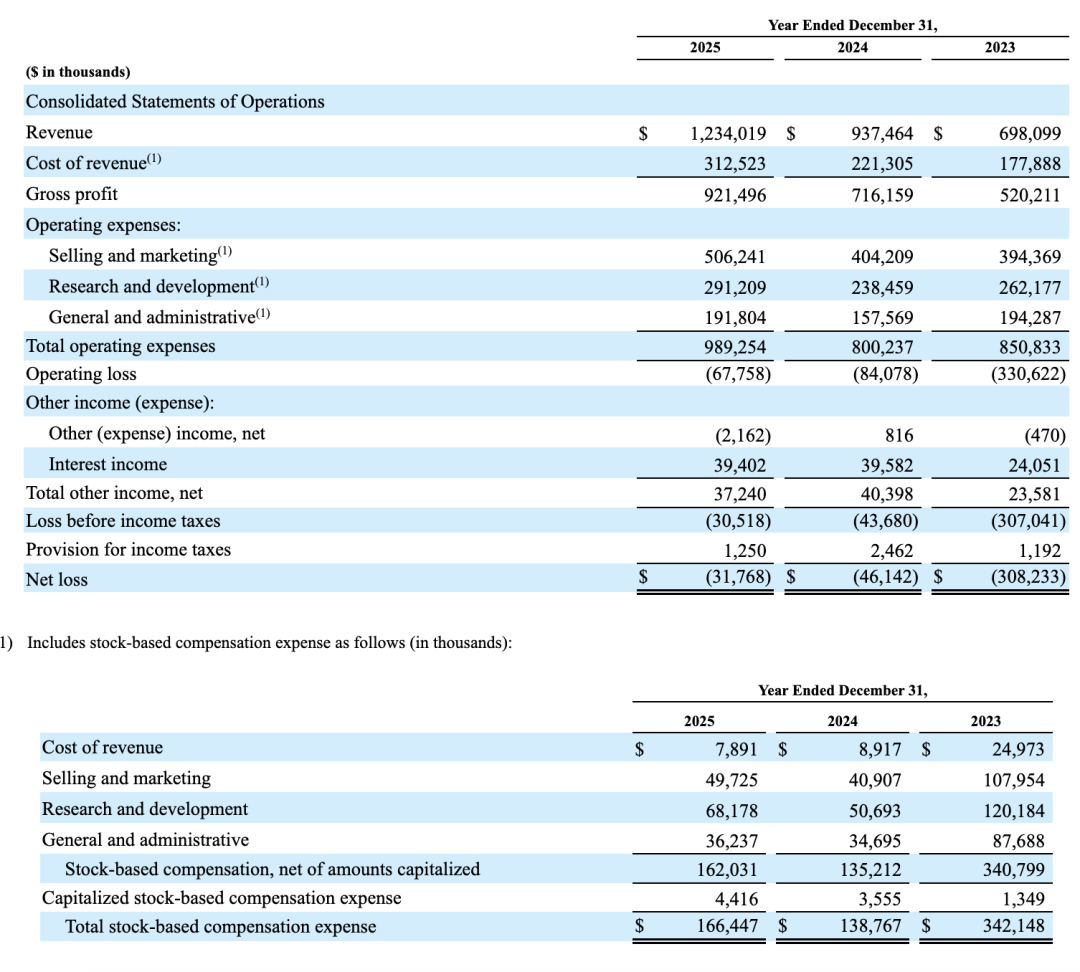
In other words, revenue is still growing more than 30% a year, while the business is getting much closer to profitability. Klaviyo ended 2025 with about 193,000 customers; by the second quarter of 2026, it had more than 205,000.
What interests me most isn’t the growth rate. It’s where Klaviyo’s customers come from.
As of December 31, 2025, about 77.9% of Klaviyo’s ARR came from customers who also used Shopify. More than 117,000 brands on Shopify were using Klaviyo. Compare that with Klaviyo’s total of more than 205,000 customers in Q2 2026: Shopify users likely accounted for more than half its customers, yet generated nearly 80% of ARR. That suggests Shopify customers are substantially more valuable than customers from other sources.
Shopify invested in Klaviyo in 2022, and Klaviyo became one of the recommended email solutions for Shopify Plus globally.
This changed how I think about a “platform ecosystem.” A sufficiently large platform can give rise to many independent SaaS companies making hundreds of millions—or even more than a billion—dollars a year.
Choosing Shopify effectively answers a series of difficult early-stage questions. Who are your users? E-commerce brands. Can they pay? Yes: they are already running businesses. Do they have a clear need? Absolutely. Acquisition, conversion, repeat purchases, win-back, and loyalty all connect directly to revenue. Where is the data? In Shopify and the tools around it. Where can you reach potential customers? Through the app store, agencies, developers, and the broader Shopify ecosystem.
The more I study SaaS, the more convinced I become that choosing a platform is choosing a market. E-commerce merchants are an especially attractive group of B2B customers.
2. Klaviyo has long been more than an email tool
If you still think of Klaviyo as a Mailchimp-like tool for sending emails, you’re underestimating what it has become.
Its product architecture now has three layers: Data, Intelligence, and Action.
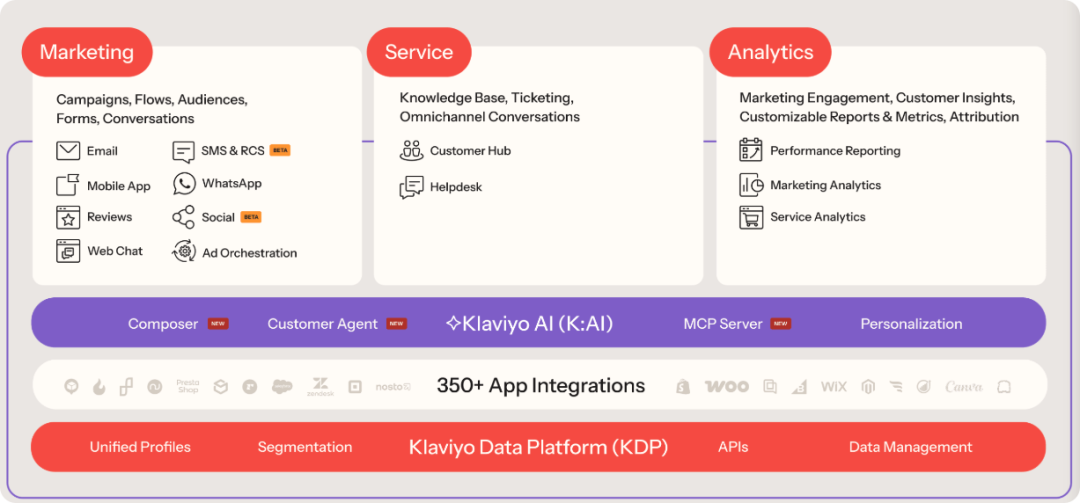
First is the data foundation. Klaviyo’s core capability is no longer simply helping merchants send emails; it’s helping them understand consumers. Merchants can bring together their first-party customer profiles, behavioral events, and data from third-party platforms. Klaviyo supports more than 350 external data sources.
That lets the system see what someone bought, which products they browsed, which emails they opened, what they clicked, how long it has been since their last purchase, how much they have spent, and where they are in the customer lifecycle.
This is the biggest difference between Klaviyo and a pure email tool. Email is the final delivery channel; the underlying consumer data is what creates the real advantage.
The next layer is Intelligence. Klaviyo uses data and machine learning to estimate a customer’s potential lifetime value, predict when they might order again, identify people at risk of disengaging, and prioritize whom to reach first.
Klaviyo now processes billions of messages and trillions of consumer events. The behavioral data flows back into the system, creating a classic data flywheel.
Only then comes Action: the marketing and service work that actually happens. Klaviyo now offers not just email but SMS, WhatsApp, push notifications, reviews, customer service, Marketing Analytics, Marketing Agent, and Customer Agent.
In September 2025, Klaviyo launched Marketing Agent and Customer Agent, making extensive use of large language models and other generative AI technology. To me, this makes Klaviyo an instructive AI SaaS case. The real value of AI isn’t adding a separate chat box next to an existing product. It’s automating more of the Data → Decision → Action chain on top of the data and workflows a business already has.
Without the underlying data, AI may do little more than generate content. With customer data, real-time behavior, and marketing workflows in place, it can actually participate in business decisions.
3. What I like about Klaviyo: the more successful customers are, the more it earns
Another thing I like about Klaviyo’s business model is how closely its revenue growth is tied to its customers’ success.
Most of Klaviyo’s revenue comes from subscriptions. Email, SMS, and WhatsApp products are priced according to factors such as seats, contact counts, and message volume; customer service features are priced based on measures such as tickets and chat volume.
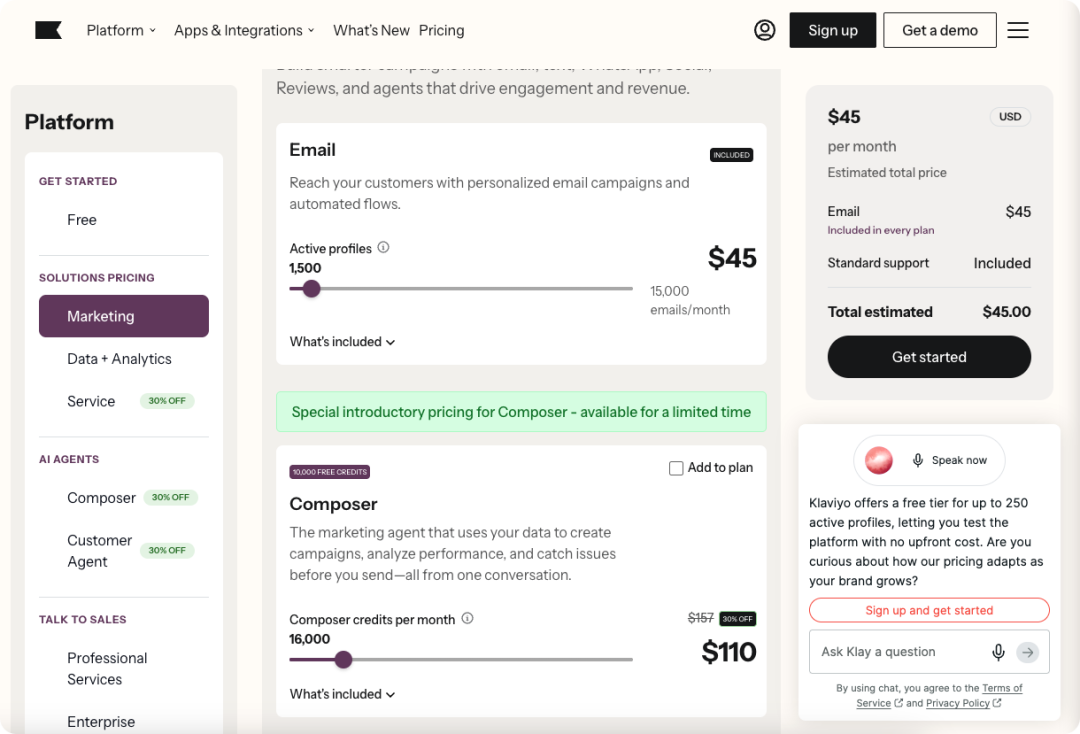
As a customer’s business grows, a series of things tends to happen naturally. The merchant has more consumers. It sends more emails and texts. It adds channels such as WhatsApp and push. The team needs more seats. Eventually, it may buy Customer Agent, Marketing Agent, marketing analytics, and other advanced capabilities.
Klaviyo’s revenue from that account grows alongside the merchant. Put differently, growth within its customers’ businesses drives Klaviyo’s expansion revenue.
To me, that’s one of the most attractive SaaS business models: your customers succeed, and you succeed with them. Klaviyo’s 109% NRR reflects that dynamic. Even without counting new customers, the existing customer base continues to generate incremental revenue.
At the same time, Klaviyo primarily uses a product-led growth (PLG) model to acquire users. Many new customers come through inbound channels: word of mouth, agency partners, commerce-platform apps, and the developer ecosystem. Once inside the product, they can connect third-party data sources, import customer information, and set up campaigns and automated flows themselves. That helps them reach value relatively quickly.
But there’s an important nuance: PLG does not mean eliminating people from the process.
Klaviyo has built a comprehensive customer experience organization. During onboarding, the team helps new customers configure the product around their business goals. Smaller customers rely more heavily on the product, self-service materials, and automated journeys to get started, adopt features, and expand. Larger customers receive more hands-on, one-to-one support, including advice on best practices, industry trends, and new features. A customer education team also provides social content, tutorials, and live training, alongside 24/7 email and live-chat support.
A mature PLG model isn’t “no sales or customer success.” It uses the product for standardized, lower-value service work, while focusing human effort on higher-value, more complex customers. What PLG really improves is the efficiency of acquiring and serving each customer.
4. From SMBs to larger accounts, then beyond e-commerce
Klaviyo initially served founders and small businesses. The challenge with SMBs is that each account tends to spend relatively little. Klaviyo’s answer wasn’t to abruptly abandon that market. It grew with its customers.
Many founders and small brands eventually became mid-sized businesses, even large organizations. As those customers grew, they needed more contacts, higher messaging volumes, more channels and seats, and more sophisticated capabilities. Klaviyo’s revenue grew alongside them.
That gave Klaviyo a natural path from SMB to mid-market to enterprise. It’s quite different from the approach of suddenly building an enterprise sales team later on and trying to win an entirely new set of large accounts.
Klaviyo looks more like a company that first built a large pool of SMB customers, then saw more and more large accounts emerge from that pool.
After establishing strong data, automation, and customer-relationship capabilities in e-commerce, Klaviyo also began expanding into education, entertainment and events, attractions, travel, and other consumer-service industries. It even has some B2B customers now.
That’s another expansion pattern I believe in: start with one vertical, then broaden into adjacent markets.
5. Studying Klaviyo convinced me that the first SaaS decision is which market to serve
My main takeaway isn’t “email marketing is a huge market.” It’s that a good niche market can keep creating growth opportunities for the company that serves it.
Shopify gave Klaviyo much more than traffic. In one ecosystem, it helped address a series of hard early SaaS questions: where users are, who they are, whether their problems are clear, whether they can pay, where the data lives, how to reach them efficiently, and how to increase average revenue per user as their businesses grow.
If I were reconsidering where to start with a new SaaS product today, I would put market selection before features.
I would first ask how much revenue the market could support and how much real revenue already exists. Who are the target customers, and what can they afford? Is the need frequent, essential, or directly tied to revenue? Can the product’s value connect to customers’ business outcomes? Is there a platform or ecosystem that makes it possible to find and reach those users at a reasonable cost?
Only after answering those questions would I decide what form the product should take, how to price it, whether to use PLG or sales-led growth, and how to compete.
Choosing a platform means choosing users; choosing users means choosing a market.
Klaviyo grew out of Shopify’s ecosystem into a publicly traded SaaS company with more than $1.2 billion in annual revenue. The lesson isn’t simply that the email marketing market is large. It points to a more useful growth path:
Instead of chasing a theoretically limitless market from day one, find a small segment where the commercial value is high, customers are concentrated, and the need is clear. Win that valuable foothold first, then expand the boundaries of both your product and your customer base.
For a new SaaS company, I increasingly believe that’s the stronger starting point.
Hi, I’m Renee.
I lead SaaS operations and am a big believer in product-led growth. I share SaaS earnings analysis and growth strategy here. If you work on SaaS, I’d love to talk shop.