monday.com Is Still Growing. What's Driving the Next Phase?
A closer look at monday.com’s customer mix, expansion revenue, new products, profitability, and path toward an AI work platform.
In this article 13
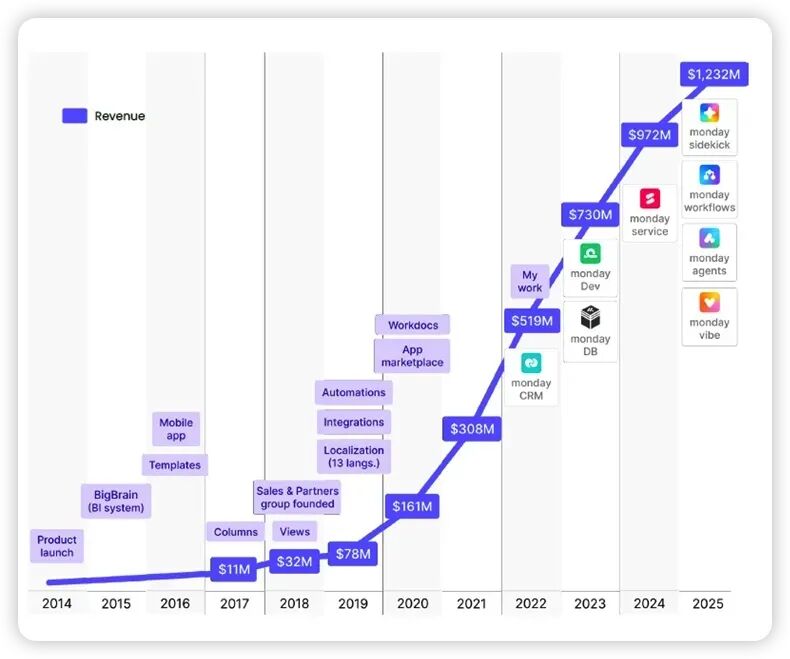
monday.com is worth watching in the work-management market. Revenue has grown quickly over the past three years, but growth has steadily slowed. The sources of that growth are changing, too.
Five things have been happening at once:
- Growth in the overall paid-customer base is slowing.
- Mid-sized and large customers account for a rising share of revenue.
- Expansion within existing accounts is becoming a more important growth driver.
- The company is moving beyond project management into CRM, software development, service management, and AI-powered work.
- It has essentially reached operating break-even while continuing to grow.
1. monday.com is no longer just project-management software
monday.com began primarily as a project and task-management tool. Teams could create tasks, assign owners, set deadlines, track progress, and use boards and dashboards to coordinate their work.
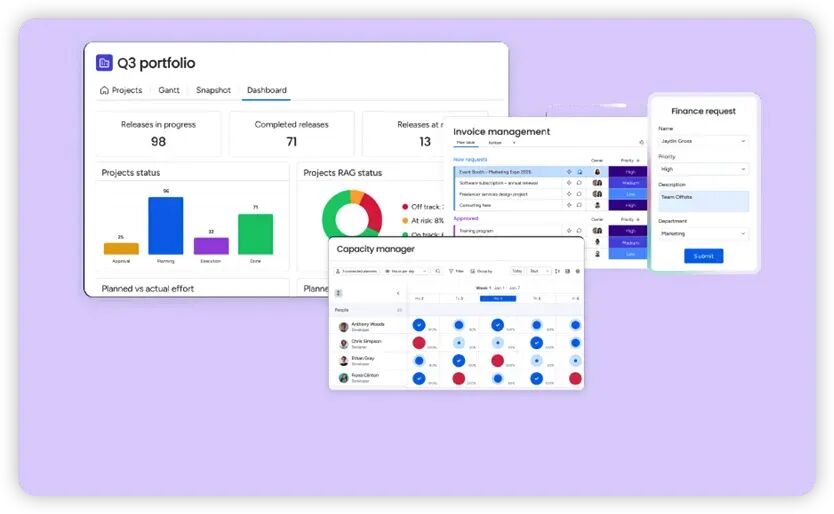
Today, a more accurate description is a Work OS: a low-code/no-code platform on which companies can build, manage, and automate internal business processes.
It brings work that would otherwise be scattered across spreadsheets, email, chat, documents, and separate business applications into shared workflows. In one system, a company can see what needs to be done, who owns it, how far along it is, when it is due, how tasks depend on one another, and where work is at risk.
What monday.com sells goes beyond task management. It helps companies organize, track, and automate work across teams—more like a shared system for running business workflows.
That said, monday work management still generates the vast majority of revenue. CRM, Dev, Service, and other newer products are growing quickly, but they have not displaced the core work-management product.
2. Its typical growth path: land with one small team, expand across the company
The path looks like this:
Self-serve signup by a small team → adoption in one department → more seats → adoption by other departments → additional products → enterprise account
That combines three growth motions:
- Product-led growth (PLG): small teams can sign up, try the product, and buy directly.
- Sales-assisted growth: sales helps promising accounts broaden their use.
- Enterprise sales: a longer, higher-touch sales cycle wins large organizations.
3. Who buys monday.com, and who actually uses it?
The buyer and the user are often different people.
At a small company, the buyer might be the founder or a team lead. At a mid-sized or large company, the decision may involve department heads, a project-management office, IT, information security, and procurement. They care about cross-functional efficiency, clear ownership, and visibility into progress and resources.
The actual users are everyone participating in the workflow: project managers, operations, marketing, sales, product, engineering, customer service, and other teams.
At the end of 2025, monday.com reported:
- More than 250,000 paying customers.
- 4,281 customers with annual recurring revenue (ARR) above $50,000, up 34%.
- 1,756 customers with ARR above $100,000, up 45%.
- 87 customers with ARR above $500,000.
- 63,914 customers with more than 10 users. These represented less than 25.6% of paying accounts, but 81% of ARR.
monday.com has many small paying accounts, but its revenue is increasingly concentrated in mid-sized and large customers.
4. Where does monday.com compete?
It no longer competes in just one category. It began in project management, but its broader product line now places it in work management, CRM, software-development management, service management, and AI work platforms.
Horizontal work-management platforms
The closest competitors include Asana, Smartsheet, and ClickUp. Asana is also moving from traditional project management toward agentic work management, adding AI teammates, AI workflows, and service-management capabilities. The two companies’ product directions are converging.
Lightweight tools moving upmarket
This group includes Notion, Trello, Airtable, and various AI-native workflow tools.
Large enterprise software platforms
Further upmarket, monday.com faces Microsoft, Salesforce, HubSpot, Atlassian, and ServiceNow. Their advantage is not just a particular feature. It is their installed software ecosystems, customer data, sales channels, and procurement relationships.
monday.com needs to show not only that it is easier to use, but also that it delivers a meaningful improvement in process efficiency.
5. Revenue growth slowed each year from 2023 through 2025
The company is still growing quickly, but the slowdown is clear.
| Metric | 2023 | 2024 | 2025 |
|---|---|---|---|
| Revenue | $730 million | $972 million | $1.232 billion |
| Revenue growth | 41% | 33% | 27% |
| GAAP net income | −$1.9 million | $32.4 million | $118.7 million |
| Adjusted free cash flow | $204.9 million | $295.8 million | $322.7 million |
| Free-cash-flow margin | 28.1% | 30.4% | 26.2% |
| Overall net dollar retention (NDR) | 110% | 112% | 110% |
| Gross margin | ~89% | ~89% | ~89% |
Growth went from 41% to 33% to 27%. In Q1 2026, revenue was $351 million, up 24% year over year, continuing the slowdown.
monday.com is moving from a period of rapid expansion toward growth at scale.
6. The business is near operating break-even
In 2025, its GAAP operating loss narrowed to just $1.7 million—close to break-even. Its GAAP operating margin reached 6% in Q1 2026, compared with 3% in the year-earlier quarter.
| Operating result | 2023 | 2024 | 2025 |
|---|---|---|---|
| GAAP operating profit (loss) | −$38.6 million | −$21.0 million | −$1.7 million |
| Non-GAAP operating profit | $61.6 million | $132.4 million | $175.3 million |
The company’s 2025 net income was substantially higher than operating income, in part because of interest income and tax items. To judge the profitability of the core business, operating income and free cash flow are more useful than net income alone.
7. Mid-sized and large accounts now generate most of the revenue
Customers with more than 10 users make up only about a quarter of paid accounts, but contribute more than 80% of ARR.
| Period | Total paying customers | Customers with 10+ users | Share of accounts | Share of ARR |
|---|---|---|---|---|
| End of 2023 | More than 225,000 | 53,688 | Less than 23.9% | ~78% |
| End of 2024 | ~245,000 | 59,214 | ~24.2% | 79% |
| End of 2025 | More than 250,000 | 63,914 | Less than 25.6% | 81% |
| Q1 2026 | Not disclosed | 65,016 | Not calculable | 82% |
Growth in the number of these accounts slowed from 10% to 8% to 7%. Yet their share of ARR rose from 78% to 79% to 81% to 82%.
That tells us growth is no longer just about adding more mid-sized customers. Existing customers are adding seats, expanding to other teams, upgrading to enterprise plans, buying more products, and increasing contract value.
8. The number of high-value customers is still rising quickly
| Period | Customers with ARR above $50,000 | Year-over-year growth | Customers with ARR above $100,000 | Year-over-year growth |
|---|---|---|---|---|
| End of 2023 | 2,295 | 56% | 833 | 58% |
| End of 2024 | 3,201 | 39% | 1,207 | 45% |
| End of 2025 | 4,281 | 34% | 1,756 | 45% |
| Q1 2026 | 4,547 | 32% | 1,844 | 39% |
Customers with ARR above $50,000 generated about 32% of ARR in 2023, 41% in 2025, and 42% in Q1 2026.
Even as overall revenue growth slows, expansion in larger accounts remains a powerful source of growth.
9. Stable NDR shows that existing customers are still expanding
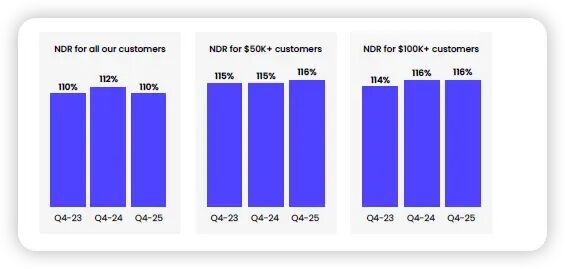
An NDR of 110% means that the same customer cohort generated roughly 10% more revenue than a year earlier after accounting for expansion, contraction, and churn.
The 2025 report’s chart shows that overall NDR was 110% in Q4 2023, 112% in Q4 2024, and 110% in Q4 2025. For customers with ARR above $50,000, the corresponding figures were 115%, 115%, and 116%; for those above $100,000, they were 114%, 116%, and 116%. The higher-value cohorts expanded faster than the customer base as a whole.
10. How much growth comes from new versus existing customers?
A very rough way to inspect the mix is:
Total revenue growth − the portion of NDR above 100% ≈ growth percentage points attributable to new customers and other factors
| Period | Revenue growth | Net expansion implied by NDR | New customers and other factors (rough estimate) | Rough share of total growth |
|---|---|---|---|---|
| End of 2023 | 41% | 10 percentage points | 31 percentage points | 75.6% |
| End of 2024 | 33% | 12 percentage points | 21 percentage points | 63.6% |
| End of 2025 | 27% | 10 percentage points | 17 percentage points | 63.0% |
| Q1 2026 | 24% | 10 percentage points | 14 percentage points | 58.3% |
This is only a directional estimate, not a formal financial breakdown. Revenue growth uses GAAP-recognized revenue; NDR is generally based on ARR or annualized subscription revenue. Their definitions and measurement periods do not perfectly match.
Still, the trend is useful: monday.com increasingly relies on steady expansion from existing customers, while the estimated contribution from new customers and other factors is declining.
11. How much revenue do the newer products contribute?
monday.com does not provide a complete revenue breakdown by product. Two product-level disclosures are available:
- monday CRM exceeded $100 million in ARR in Q2 2025.
- In Q3 2025, newer products including CRM, Dev, and Service together contributed more than 10% of company ARR.
The careful conclusion is that, as of the second half of 2025, new products generated more than 10% of ARR combined. Core work management still generated the vast majority.
12. Where could monday.com’s future growth come from?
1. More work-management products
monday.com wants to cover more departments and work scenarios, not just project management. Each additional product creates opportunities to win new departments, cross-sell to existing customers, and raise contract value.
2. A suite built around how companies work
The underlying platform can support marketing, sales, engineering, service, and operations. monday.com wants to evolve from a point solution into a shared work platform for the business.
3. More value through AI
In 2026, the company began emphasizing an AI Work Platform more explicitly. AI could go beyond drafting text to creating tasks, updating statuses, flagging project risks, assigning work, executing processes, and collaborating with employees.
If AI actually completes work for customers, monday.com may be able to supplement seat-based pricing with charges for AI credits and work performed.
4. Greater adoption inside the existing customer base
More than 250,000 paying customers provide a strong starting point for new-product distribution. Rather than acquiring every customer from scratch, monday.com can sell CRM, Dev, Service, AI capabilities, and enterprise plans to customers it already serves.
5. Enterprise and international expansion
The company continues investing in enterprise sales, partners, international markets, enterprise-grade security and governance, and support for large accounts.
13. How I see monday.com’s position today
With one core product still accounting for most revenue, monday.com appears to be entering a more mature growth phase. Annual revenue growth slowed from 41% in 2023 to 24% in Q1 2026. Overall NDR among paying customers is 110%, while my rough estimate of the contribution from new customers and other factors has fallen to roughly 10–20 percentage points of annual growth.
Expansion and renewals are doing more of the work. The number of customers with more than 10 users grew 7%, while the counts of customers above $50,000, $100,000, and $500,000 in ARR continue to grow strongly. That reinforces the view that most core revenue growth now comes from expansion; there may also be some churn at renewal, concentrated among smaller teams.
Growing large accounts requires progress on two fronts. First, make the core product more valuable with AI, so existing customers add seats or capabilities. Second, invest in building complementary software—CRM, developer tools, and customer-service products—to create cross-selling opportunities. monday CRM reaching $100 million in ARR in 2025 suggests that cross-selling can work in this category.
The overall motion remains PLG + sales assistance + enterprise sales. But as growth among smaller customers slows, enterprise selling becomes more important to revenue growth.
What monday.com needs to prove next is not simply that it can add more product modules. It needs to show that it can become the platform where teams manage everyday work—and increasingly use AI to get that work done.
The decisive question is no longer just how many more paying customers it can acquire. It is whether existing customers will entrust more departments, workflows, budget, and eventually AI workloads to monday.com.
Hi, I’m Renee.
I lead SaaS operations and am a big believer in product-led growth. I share SaaS earnings analysis and growth strategy here. If you work on SaaS, I’d love to talk shop.